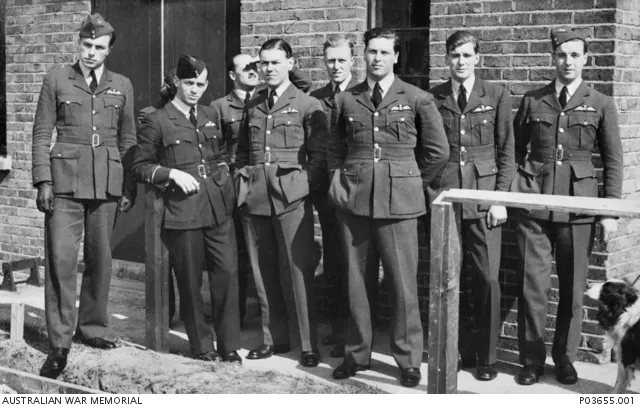
Charles Gordon Challoner Olive was born on 3 July 1916 in Brisbane. He attended Brisbane Grammar School and Brisbane University before winning an RAAF cadetship in January 1936. After training in Australia, in 1937 he joined the RAF to learn to be a fighter pilot, where he mostly trained with the slow and unwieldy Gloster Gladiator biplanes. He was also an accomplished athlete, breaking the RAF javelin record in 1939.
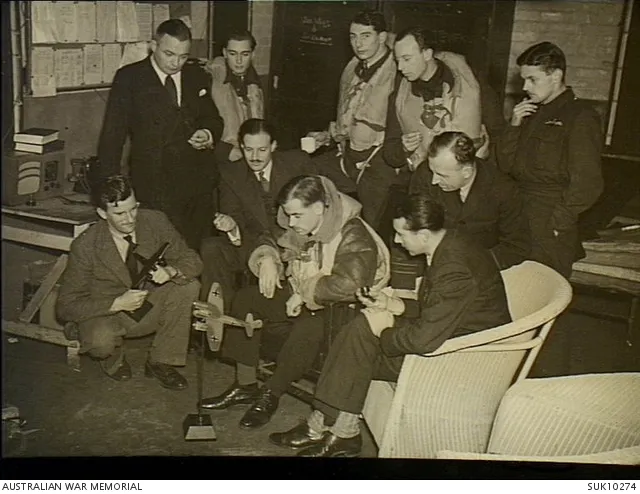
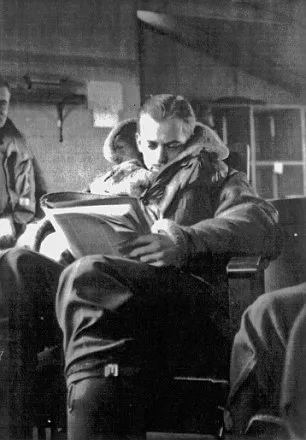
Olive won the Distinguished Flying Cross in September 1940 at the age of just 24. He flew an heroic 193 sorties during the Battle of Britain with No. 65 Squadron RAF, claiming 5 confirmed kills. He later became the first Commanding Officer of No. 456 Squadron, the RAAF's only night fighter squadron in the Second World War. He rose to the rank of Acting Wing Commander and rejoined the RAAF in 1943.
In Wing Commander Olive's own words:
"One misty afternoon in the spring of 1939, a small, sleek aeroplane of unprecedented beauty flew around our aerodrome and glided in to a perfect landing. A pilot in civvies got out and strolled over to report that he was delivering our first Spitfire. As a work of art, I doubt if any machine ever made approached its exquisitely beautiful lines. But the first time I flew one I got the fright of my life. The stick in the pilot's left hand controlled the elevator flaps, and it was very sensitive. To the right was a hand-operated hydraulic pump that retracted the undercarriage. After take-off, I started to pump the wheels back into the fuselage and the Spitfire porpoised so violently I was almost flung out of the cockpit."
"My first combat came over Calais, on the first day of the Dunkirk evacuation: May 26, 1940. Shortly after 9am we saw a formation of 20 or more ME 109s diving in on us almost out of the sun. They were already firing when we spotted them. They slid by underneath us in groups of two and four, passing close enough for us to see the pilots' eyes. Their oxygen masks made them look like monkeys."
"Suddenly the air around me was criss-crossed with tracer. I turned violently and saw two ME 109s on my tail, firing. Another one, a big fat plane, flew across my sights and I fired for the first time in action, seeing him roll over and dive into the cloud below."
"One afternoon, I was flying at the head of a three-man patrol when we blundered into 36 ME 109s. Diving under one row, I executed a steep climbing turn at the lowest speed I dared — about 140mph, turning far tighter than any Messerschmitt could follow. The tail-end Charlie was in my sights now, and my Spitfire slowed and nearly stalled as my guns roared. The enemy rolled and vanished, and I homed in on the next. Numbers 8, 7, 6 and 5 followed suit. No 4 was a beautiful target — he just gently dived away, pieces flying off him. I gave chase, wanting to see him blow up, but by doing this I showed my own tail to his squadron leader."
"CRASH! BOOM! Something exploded under my seat. The armour plate behind me rang like a bell and there was a disgusting stench — explosive shells bursting inside the fuselage. The Spitfire reared up and hurtled into a loop so savage that I blacked out. Coming out of my stupor at the top of the loop, I rolled into a tight turn again and the remaining three ME 109s were right in front of me. I pressed the button and nothing happened. I was out of ammunition. But No 3 knew I was behind him and panicked, diving for the deck. The other two followed."
"I was still alive but there was petrol sloshing around in the bottom of the Spitfire. My right boot was soggy and squelching with blood. I nursed the plane back to the first aerodrome I saw on the Kent coast, and landed belly-first, with no undercarriage and no brakes, on the grass. When I made it back to my squadron, I discovered I was reported missing, believed dead."
"At 500ft one morning, moments after take-off, my oxygen regulator dial blew up. Dense smoke filled the cockpit and I knew I had just seconds before the fire heated the petrol tank to flashpoint. I couldn't bale out at that height, as the chute wouldn't have time to open. So I wrenched the plane into a steep climb, unbuckled my seat harness and tore off my helmet. As the Spitfire stalled at the top of its climb, I kicked the rudder hard to the left, blowing the flames to one side of the cockpit. Then, jumping up onto the seat, I leapt out into the cool, sweet air."
"As I pulled the ripcord, the pilot chute snared around my boots. I wrestled to free it. After what seemed an age of freefalling, I felt a violent jerk and the chute opened. I landed on a heap of potatoes, and when I got my wind back there was a crowd of Land Army girls around me. 'Ee, luv,' said one chubby lass, holding up my parachute, 'this'd make luvly knickers!'"
Olive used to tell his pilots the tale of a particularly memorable incident. Once when he bailed out, his parachute nearly failed to open. When he landed in a paddock, he was confronted by members of the Land Army and Home Guard, and had to convince them he was not German. That accomplished, he thought he'd made it, but the ambulance taking him back to the aerodrome overturned. He scrambled out with a few more bruises, and was then picked up by a fire engine dashing to the spot where his Spitfire was burning itself out. The fire engine, too, ended up a minute later in the ditch. "After that, I decided to walk." And that is why the Wing Commander always told his pilots that they were safer in the air.
Olive's biography, "The Devil at 6 O'Clock: An Australian Ace in the Battle of Britain," was published in 2001.