
Desmond Sheen had been dreaming of flying ever since he had witnessed the great aerial display that had been laid on as part of the celebrations for the opening of Parliament House in May 1927. He clearly remembered one of the air force DH9s landing in a field not far from his house. From that moment, he was 'hooked' and his ambition was to join the air force. He sent in an application for a Royal Australian Air Force (RAAF) cadetship as soon as he turned 18 on 2 October 1935 and was selected for 1 Flying Training School's 19 Course, which commenced on 20 January 1936. When the course concluded in December 1936, graduates were given the choice of joining the RAAF on a four year short service commission, or the Royal Air Force (RAF) on a five year commission.
Desmond decided he would join the RAF and embarked for England on 9 January 1937. He was officially sworn in as a member of the RAF with the rank of Pilot Officer on 19 February. After two weeks at RAF Uxbridge, he was posted briefly to 3 Fighter Training School at Grantham and then, on 22 March to 9 FTS, Thornaby. On 30 June, at the completion of his training, he was posted to B Flight of 72 Squadron at Church Fenton in Yorkshire, the first RAF squadron to be equipped with Gloster Gladiators.
Desmond was promoted to Flying Officer on 19 September 1938, during the height of the Munich Crisis. The nation rejoiced when British prime minister Neville Chamberlain declared 'peace for our time' after he signed a non-aggression pact with Germany, but the RAF was not convinced and continued its preparations for the inevitable conflict.
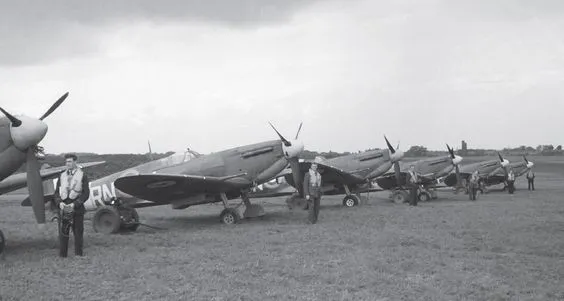
A number of squadrons had already begun re-equipping with modern fighters and in April 1939 72 Squadron's complement of Spitfires began to arrive. Desmond took his first flight in a Spitfire on 14 April. Paying homage to his homeland, Desmond had a reddish brown boomerang, against a white circle background, painted on the cockpit entry hatch of his favourite Spitfire.
Six weeks after the declaration of war, 72 Squadron moved to Leconfield, also in Yorkshire. Fighter Command was divided into a number of groups which had operational responsibilities for specific areas of the United Kingdom. 11 Group covered London and the south of England, 12 Group was responsible for defending central England and Wales and 13 Group covered England's north as well as Scotland. Leconfield was under 13 Group's jurisdiction and tasked with carrying out convoy escorts and patrols.
Fighter Command had few noteworthy encounters with the enemy during the Phoney War period. When Desmond looked back on those months he recalled that he had flown about 700 hours in fighter aircraft but in all that time there were only about 20 minutes that he would never forget. Five of those 20 related to his first combat on 21 October, against Heinkel He 115 floatplanes which had threatened a convoy off Spurn Head. He described that brief combat as 'really good fun — as exciting a five minutes as anything you could wish for'. On that day, just 19 days after his 22nd birthday, Desmond had shot down one of the floatplanes, becoming the first Australian to engage the enemy in combat.
The other 15 minutes, which proved to be 'the most hectic 15 minutes of my life, in fact they nearly put an end to it' occurred just after mid-day on 7 December 1939 when 72 Squadron encountered a formation of Heinkel He 111 fast medium bombers north of Arbroath. Desmond attacked one of the bombers and was credited with a third share. He was wounded in the encounter and believed that he had 'the doubtful distinction on this occasion of being Fighter Command's first casualty of war.' He was hospitalised and did not return to operations until after Christmas.
Desmond's actions of 21 October and 7 December were recognised with the award of the Distinguished Flying Cross, which was gazetted on 7 May 1940.
72 Squadron returned to Church Fenton in January 1940 and then moved to Acklington, in Northumberland, on 2 March. It was a quiet period for 72 Squadron and Desmond, with little work to do but convoy escorts and patrols. Desmond was getting bored but was soon given the opportunity to participate in some different work when he was selected to join the Photographic Development Unit which was tasked with carrying out secret reconnaissance flights over Europe.
Desmond had flown a number of times over Germany by the time the Phoney War ceased abruptly on 10 May. It was expected that Italy would soon enter the war so Desmond flew to Le Luc in the south of France. From there, he photographed Italian bases.
Italy declared war on France and Great Britain on 10 June and the Germans entered Paris on the 14th. Desmond's base was bombed by the Italians and only one Spitfire remained serviceable: all the rest had been destroyed on the ground. One of the pilots flew the Spitfire back to England and Desmond and the rest of the unit made their way to the Royal Navy training station at nearby Hyeres. On 17 June, the day before the last RAF Squadron based in France withdrew, Desmond and a small party commenced a circuitous journey to Gibraltar and eventually England, arriving at Liverpool on 12 July.
Soon after arriving back in England, Desmond asked to rejoin his old squadron. Although it was not acknowledged as such for some years, the Battle of Britain had commenced. During the Battle of France, the RAF had lost 110 pilots and now desperately needed to swell its ranks. Desmond's request was granted and he returned to 72 Squadron at Acklington on 29 July.
11 and 12 groups, along with 10 Group which had recently formed to defend the southwest, were getting plenty of action, but 72 Squadron in 13 Group had been kicking its heels in the north. Over the last weeks, when they had not been frustrated by poor weather, they had been carrying out training flights or were on routine readiness with the usual sort of non productive convoy patrols. The squadron was anxious to get down south where the main action was. It didn't have long to wait.
On 13 August the Luftwaffe launched its main assault on Britain, a series of carefully synchronised attacks on the south of England. These had met with some success but on the whole, the German air force had encountered a determined resistance from the RAF. On 15 August, using almost its entire resources, the Luftwaffe's Luftflotten 2 and 3 based in France and Luftflotte 5 based in Norway launched a day-long series of attacks on Britain in an attempt to saturate RAF defences. It was a mighty force, where almost the entire British Isles was within the range of Luftwaffe bombers.
A heavy raid aimed at Edinburgh was identified and the whole of 72 Squadron was ordered to readiness at 12.10 p.m. Five minutes later they scrambled and 11 Spitfires, led by Flight Lieutenant Edward 'Ted' Graham, took to the air. They were vectored to the Farne Islands to intercept a large formation of Heinkel He 111 medium bombers and their escort of Messerschmitt Me 110 heavy two-engined fighters.
72 Squadron arrived at 18,000 feet. Desmond was Green leader and led two sections of two aircraft. The enemy aircraft were flying in vics on a broad front with successive squadrons astern. Desmond thought the German onslaught looked like a large swarm of bees and, as he headed towards it, all he saw was line upon line of bombers.
Graham ordered Desmond and his flight to patrol both flanks of the bombers as rearguard at 21,000 feet. Coming from the seaward side, with the sun shielding his attack, Graham led Blue and Red sections through a gap between the lines of bombers and their fighter escort. When the enemy formation split up Desmond eased his Spitfire into a circle of Me 110s and closed on one at about 200 yards range dead astern and slightly below. He opened fire and his second 3-second burst hit the aircraft and it exploded into a mass of flying debris, through which Desmond was forced to fly. He emerged unscathed then climbed and spotted another circle of Me 110s.
"Another showed signs of attacking me and a deflection shot approaching head on was tried. This was not successful but another enemy aircraft appeared in the sights head on and a no deflection shot was made. Immediately flame and smoke appeared near the inside of the port engine. The enemy aircraft either with the pilot shot or in a deliberate attempt to ram me approached head on left wing low. Violent evasive action was taken and the aircraft disappeared over my head with the flame and smoke greatly increasing in volume. No evasive action was taken by the [Me 110] and no return fire of any description was encountered from either the enemy aircraft."
As the sky 'then appeared unaccountably empty' Desmond returned to base and refuelled. The battle had lasted five minutes. All of 72 Squadron's Spitfires returned home safely. Immediately after refuelling they were in the air again on another patrol, but no enemy aircraft were seen.
Desmond noted in his log book his claims of two Messerschmitt Me 110s and a 'squadron bag' of eleven. His personal total was now 3 1/3 destroyed. For the Germans, Black Thursday resulted in 76 aircraft shot down. Luftflotte 5 had a large share of those losses and limped back to Norway, never again to launch a daylight attack on the north. Fighter Command too had its losses: 17 killed and 34 aircraft destroyed. Even so, it was a successful day for Fighter Command. It had more than held its own in what was by far the largest air battle in which it had engaged.
There was great jubilation in 72 Squadron after the 15 August battle but the main action was still down south and the next few days offered little more than uneventful patrols. 11 Group squadrons continued to be battered over the next two weeks and remnants of some were sent north to recover. On 31 August, 13 Group ordered 72 Squadron to Biggin Hill to replace 610 Squadron. The squadron arrived mid-afternoon at a station that had been bombed the day before and again just a few hours ago. Hangars had been blown up and several buildings were just rubble. Both male and female station staff had pitched in to fill the bomb craters on the grass airfields. Even so, only one landing strip was serviceable. That wasn't in the best condition and it took some time to land because the Spitfires had to pick their way through the hastily filled bomb craters.
After the Spits refuelled, 72 Squadron was called to readiness and at 5.50 p.m. were scrambled for a patrol 10 miles south of Maidstone. For Desmond, it was a less than auspicious start to 11 Group operations. His Spitfire would not start after it had been refuelled. He just watched as the other Spitfires took off and disappeared. Eventually his engine started. He took off not a moment too soon as the enemy bombers returned at 6.00 p.m. to bomb Biggin Hill yet again. Desmond did not catch up to his squadron so conducted a lone patrol over Kent, returning later to an airfield that had received another pasting.
Biggin Hill was unserviceable so, at 6.00 the next morning, the squadron evacuated to nearby Croydon. Within hours of arriving the squadron was in the air again. Led by Flight Lieutenant Ted Graham, the squadron scrambled at 10.54 a.m. in search of enemy aircraft over Tunbridge Wells. Roughly 30 Dornier Do 17Z light bombers, escorted by about the same number of Me 109E single-engined fighters, were sighted at Tunbridge at about 30,000 feet. The chase was then on between Maidstone and Beachy Head. Desmond soon lined up a bomber but then he "glanced behind and found six Me 109s bearing down on me. Despite my frantic twisting and turning my engine was hit by a cannon shell and burst into flames. I was left with no option and quickly baled out."
He landed safely in a field at Ashford.
The next days were busy. 72 Squadron flew a number of hectic sorties with some success. On 4 September the squadron was scrambled at 12.55 p.m. It was just one of nine squadrons to intercept a 300 aircraft formation comprising Junkers Ju 88 high speed bombers and their Me 110 escort which was attacking south east Kent. Flying Officer Jimmy Elsdon led 72 Squadron: six Spitfires were in his main formation and three, including Desmond, were in the rearguard. Elsdon ordered Red and Yellow sections into line astern for the attack. As he did so, the enemy formation broke up and attempted to form defensive circles but before they could, Elsdon led his six Spitfires into the first six of the enemy aircraft, shooting the enemy leader as he did so. Dogfights then occurred and Desmond and the other rearguard pilots went to assist Elsdon. Desmond "carried out a quick attack from above on a Me 110 going into the circle. White smoke immediately began to come from the port engine. I broke off the attack and climbed up to keep a further look out for escort fighters. None were seen and as the remainder of the formation of enemy aircraft had disappeared I returned to base."
Desmond claimed a probably destroyed when he returned and this was his last claim during the Battle of Britain. His battle total was two destroyed plus this probable. His total claim to date was 3 1/3 destroyed and one probable.
That evening, the pilots headed for London for one of their rare breaks during this period. They had much to celebrate: their victories over the last few days; a wire from 11 Group congratulating them for their good work; safe bale outs; and, for Desmond, his second stripe, as his promotion to Flight Lieutenant, effective from 3 September, had come through.
The Luftwaffe continued its assault on the airfields of the south east. 72 Squadron was ordered to patrol Hawkinge airfield on 5 September. Ranks were seriously depleted with a number of Spitfires destroyed or unserviceable so only eight Spits were airborne that afternoon. Desmond was leading. At 2.25 p.m. they encountered two formations of Me 109s. They were still climbing to get above the raid which was approaching from the east and were about 25,000 feet high. Then Desmond "heard a shout of warning from one of our fighters weaving behind but before I could do anything about it there was a terrific bang from behind the cockpit and the aircraft shuddered from what must have been an accurate and heavy burst from dead astern. I knew I had been hit in the leg and my left hand showed signs of flying fragments."
Desmond passed out and as he came to his Spitfire was diving vertically and out of control. He then "tried the control column but it was useless so I prepared to bale out. As soon as I undid my harness the suction lifted me out of the cockpit. Unfortunately, it did not quite do the job and in some strange way my feet caught under the windscreen. There I was in a flat out dive, lying along the top of the cockpit with my feet fastened. I had given up hope when my feet suddenly became free and almost by instinct I suppose, I pulled the ripcord from my parachute. I discovered afterwards that I was only about 800 feet up when I pulled the cord."
Desmond's fall was broken by tree branches but he was injured and hospitalised, followed by some weeks on sick leave. The squadron was relieved on 13 October and returned to Leconfield. It had participated in almost daily air battles and had achieved much success but it had paid a tremendous price: nine pilots died during the Battle of Britain and it lost 24 Spitfires, including Desmond's two. The Battle of Britain officially concluded on 31 October 1940 but it was effectively over for Desmond on 5 September. He was just shy of his 23rd birthday.
Desmond returned to 72 Squadron in mid-October. He was appointed flight commander of A flight and then squadron commander on 28 March 1941, shortly after claiming a destroyed Junkers Ju 88 on the night of 13/14 March. By this stage of the war, the RAF was on the offensive. Many opportunistic sweeps were carried out over France and bomber squadrons were escorted by large numbers of fighters which tried to draw German fighters into combat.
On 29 August 1941 Desmond led 72 Squadron as part of a large formation escorting bombers to Hazebrouck marshalling yards in northern France. As they crossed the coast, 72 Squadron sighted a large number of Me 109s. Desmond determined that they were a serious threat to the squadron so he led his Spitfires into a fierce running battle. Desmond claimed a damaged 109, and the Squadron scored much success that day. Desmond's actions that day were recognised by the award of a Bar to his Distinguished Flying Cross. It was gazetted on 21 October 1941, the second anniversary of his first combat and enemy 'kill'.
Desmond was posted from 72 Squadron on 3 November 1941, a month after claiming a probable Me 109 on 2 October, his 24th birthday. It was his final combat claim. His official total for the war was 4 1/3 destroyed, two damaged and two probables. Desmond attained his final wartime rank of acting wing commander on 29 January 1942 and enjoyed a varied wartime career which included command and administrative posts. He was repatriated to Australia in July 1946 and rejoined the RAF on 14 July 1949. He retired on 2 January 1971 as a group captain. Looking back on his extensive and varied career with the RAF, Desmond stated that he 'enjoyed every minute of it. I was lucky all the way through with postings and I wouldn't have missed it for anything'.
Group Captain Desmond Sheen DFC and Bar died in April 2001. He was 83.
Courtesy of Wings. Journal of the Royal Australian Air Force Association Autumn 2010 Volume 62 No 1), The Spitfire Association, Kristen Alexander and Steve McGregor.