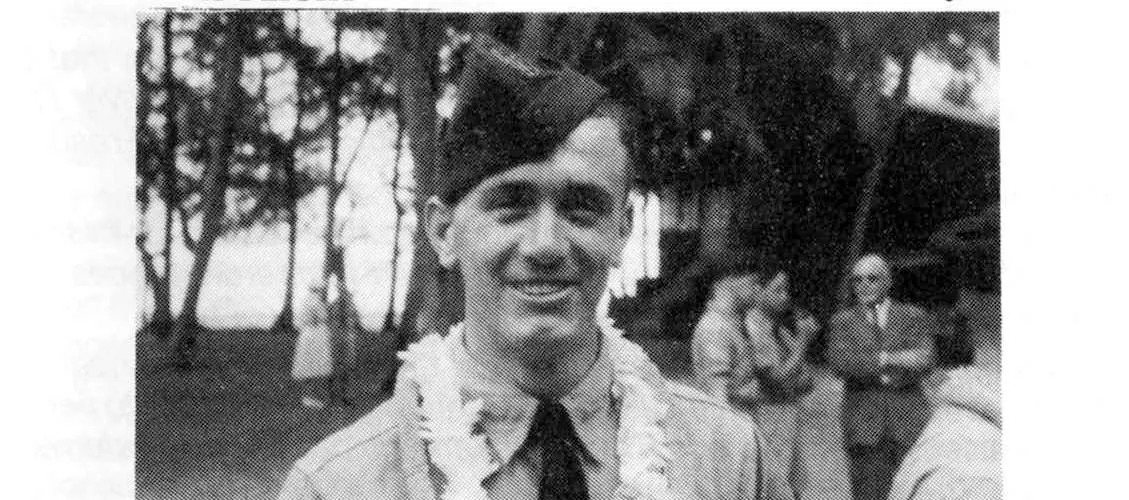
Ross Smith Stagg was born on the 15th of December 1919 and enlisted on the 3rd of February 1941. He commenced his flying training at Parafield, South Australia, and eventually graduated at Point Cook, Victoria. Ross, having trained on Oxfords, was expecting to enter Bomber Command on his arrival in the United Kingdom. Instead he applied for and was accepted for OTU training on Spitfires.
On completion of his operational training, Ross was posted to No. 452 Squadron which had only just moved to the Isle of Man after a long tour of operations at Redhill, Surrey. He was to remain with this unit until it was sent back to Australia in mid-1942 to join No. 1 Fighter Wing for the defence of Darwin.
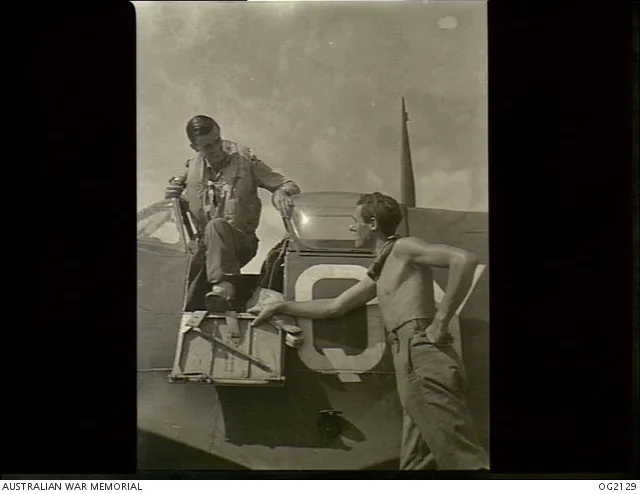
While a Flight Sergeant in 452 Squadron RAAF, he was scrambled on the 2nd of May 1943 to intercept Japanese. Ross was forced to bail out over the Timor Sea when at 32,000 feet the engine on Spitfire A58-53, lettered QY-S, seized. Like many from the wing, he was forced to abandon his Spitfire because of airscrew failure, a malfunction which resulted in the motor over-revving, seizing and in many cases catching fire.
He glided toward land but eventually fell in the sea and paddled ashore in his dinghy, accompanied all the way by a shark. He travelled east through mangroves and then a swamp of cane grass. It became so thick that he had to abandon his dinghy. Then the water became deeper and deeper so he turned back but could not find the dinghy. He camped on a dry patch but was eaten alive by mosquitoes. He turned south and finally reached a ridge where he spent the night. He then carried on, relying on his Mae West to keep him afloat in the swamp. He got in a panic when he realised he would not reach some hills and turned back to where he started. He buried himself in mud to try and keep the mosquitoes off but it did not work too well.
The next morning he tried to find the dinghy, but suffering from hunger, thirst and exhaustion he collapsed. He came to and thought that four friends of his were calling out to him. Later Spitfires circled and he found an open patch and waved his Mae West, but they flew away. One night he found a small tree and slept fitfully three feet above the water. When he finally dozed off he fell back into the water. Still hallucinating, he struggled up a mound and fell off the other side. He came to in the morning having had the first decent sleep for seven days. He was on the banks of a river and wading through thick mud, he set out to cross it. He saw a crocodile slide off the bank and come towards him. He was now floating and the current took him past a dead tree; he grabbed a branch and dragged himself to the bank, losing a boot. He had to turn and rescue the boot which had sunk in the mud.
Later he managed to find some ibis eggs and sucked them — some had chicks inside which did not impress him one bit. His feet by now were covered with pus-filled blisters. Once he trod on a goanna, he strangled it, tore open the body and ate the entrails. He carried on, crawling until he passed out.
Sixteen traumatic days later, after trudging through dense bush, he was rescued starving by a prospector and a party of Aboriginal people and taken to an Army outpost and eventually to the Adelaide River Hospital. By the time Ross was found by the Aboriginal companion of the prospector, he had travelled 140 kilometres over 15 days. His adventure found him recuperating in hospital for six months and upon being given a clean bill of health he then returned to No. 452 Squadron, which by then had moved to the islands north of Australia.
A58-53
F.VC
BR547
Arrived in Australia on SS Hoperidge 23/10/42. Rec 1AD ex UK 30/10/42. Installed Merlin 46 Eng #91355. Rec 1FW ex 1AD 09/11/42. Rec 452 Sqn RAAF ex 1FW 09/11/42. Operational Loss during Air Raid#54, with aircraft missing west of Darwin Harbour over the sea 1045hrs approx., 02/05/43. F/Sgt Ross Smith Stagg Serv#407915 (Actually promoted to P/O 01/03/43) bailed out following aerial dogfight and was picked up more than two weeks later, suffering from malnutrition and exhaustion. AMSE Write-off per File#9/16/826 02/06/43
ADF Serials
He was discharged on the 5th of October 1945.
Ross Smith Stagg of Panorama, Adelaide, South Australia, died on the 8th of July 2000.
Bill Hardwick contributed these sentiments and concluded in saying that Ross Stagg was the best mate that anyone could wish for.